
Echols County’s Periodic Arrest Archive
The ECSO Sheriff’s Reports archive sits on the arresting agency’s own domain. It offers selected monthly and combined-period PDF arrest reports rather than a rolling feed. The holdings include June through February 2024 and a combined October 2023 through January 2024 file. Older material comes from June 2019 and 2016. Call it a historical repository. It is not a promise of every month. No seven-day, ten-day, or “all recent arrests” window exists in the archive, so these are best described as selected official reports. A missing month simply means unknown coverage. For current custody, look to Lowndes, since ECSO transports its arrestees there.
Read an Echols Arrest Report
Start from the archive index. A general image or name search will not get you far here. The index gives you each report’s label and file link, and the PDF itself supplies the actual entry fields.
- Open the Sheriff’s Reports archive and identify the closest report period.
- Open the PDF and confirm that its title and dates cover the event being researched.
- Search within the document for the full name, then compare age, hometown or place, arrest date, and charge wording.
- Record the report period, file URL, and the date it was accessed. Do not rewrite arrest date as booking date.
- If a month is absent, request that exact period from ECSO instead of assuming zero arrests.
- Check Lowndes or the court when the question concerns present custody or disposition.
The captured archive index shows how the selected periods are presented.
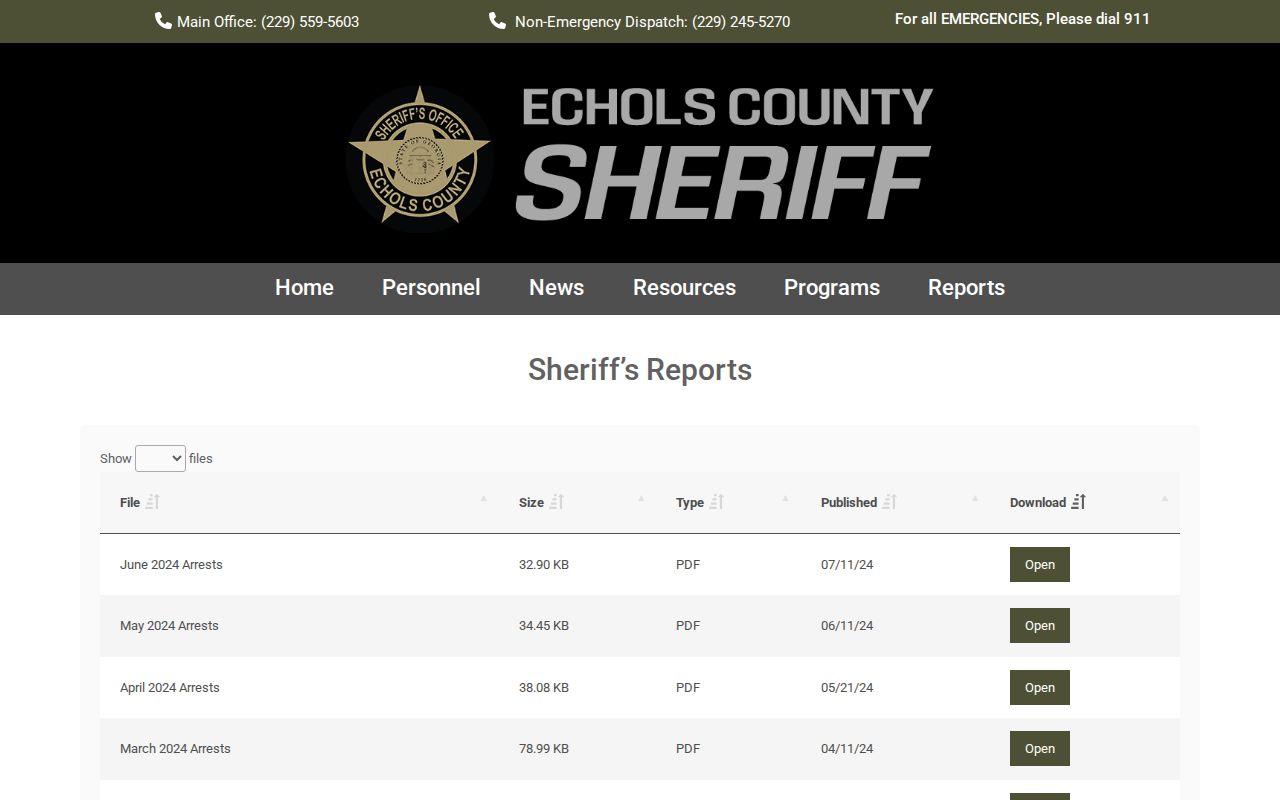
Discovery happens at the index level. Each linked PDF is the source for its own entries and deserves a direct read.
Echols Arrest Report Fields
The ECSO PDFs follow a simple structure. The June 2024 report runs one page. Its entries carry dates within that month. The March report keeps the same general form, while a combined late-2023 and early-2024 document spans two pages and contains an apparent source-date anomaly. Preserve that wording and flag it rather than silently correcting an official file.
| Field | What the PDFs establish |
|---|---|
| Arrest date | The reported event date; not necessarily booking time |
| Full name | Spelling as published by ECSO |
| Age | An added comparison point, not a complete identity match |
| Hometown/place | The place as listed, not a guaranteed current address |
| Charge | Accusation language at the report stage |
| Booking number | Not observed |
| Bond or release status | Not observed |
| Booking photo | Not included in sampled reports |
The reports document Echols County arrests; they are not a picture collection. Link the PDF, state its coverage, and let the facts stand on their own.
Monthly Posting Is Not Live
Timing matters here. The archive's own posted dates show a lag. A June 2024 report went up in July; May's went up in June. ECSO promises no fixed schedule. No rule says a report lands after every weekend or holiday.
That lag separates this page from Arrested Today. The same-day route checks Lowndes custody after transport. The archive route checks whether an arrest later entered a chosen report period. One can show a record while the other stays blank, and neither gap alone rules out the arrest.
Note: Posting date, report period, arrest date, booking time, and release date are separate facts.
Missing Echols Report Periods
ECSO's archive carries no completeness pledge. For a gap, file a targeted open-records request. Name "the ECSO monthly arrest report for [month and year]," or, for a known person, cite the arrest or incident report with full name, rough date, and case or call number. The ECSO form lists PO Box 189, Statenville, GA 31648, phone (229) 559-5603, and fax (229) 559-5678.
Fees are spelled out. The first 15 minutes cost nothing. After that, search, review, and copying run $19.55 per hour, with copies and redaction at $0.10 a page. Estimates may follow for requests above $25, and an unreturned consent form can close a file within two weeks. Allow three business days for research and five for mailing.
A booking, bond, or release paper may sit with Lowndes County Jail instead. Use the Lowndes request form for those. Split any request by which office holds the record.
News Is Not the Arrest Log
The ECSO News page and WALB Echols County News run selected stories, not full rosters. A story may add a location, an agency statement, a tip narrative, warrant origin, suspected evidence, or a transport detail the PDFs skip. Treat them as context and attribution. They are not the arrest log.
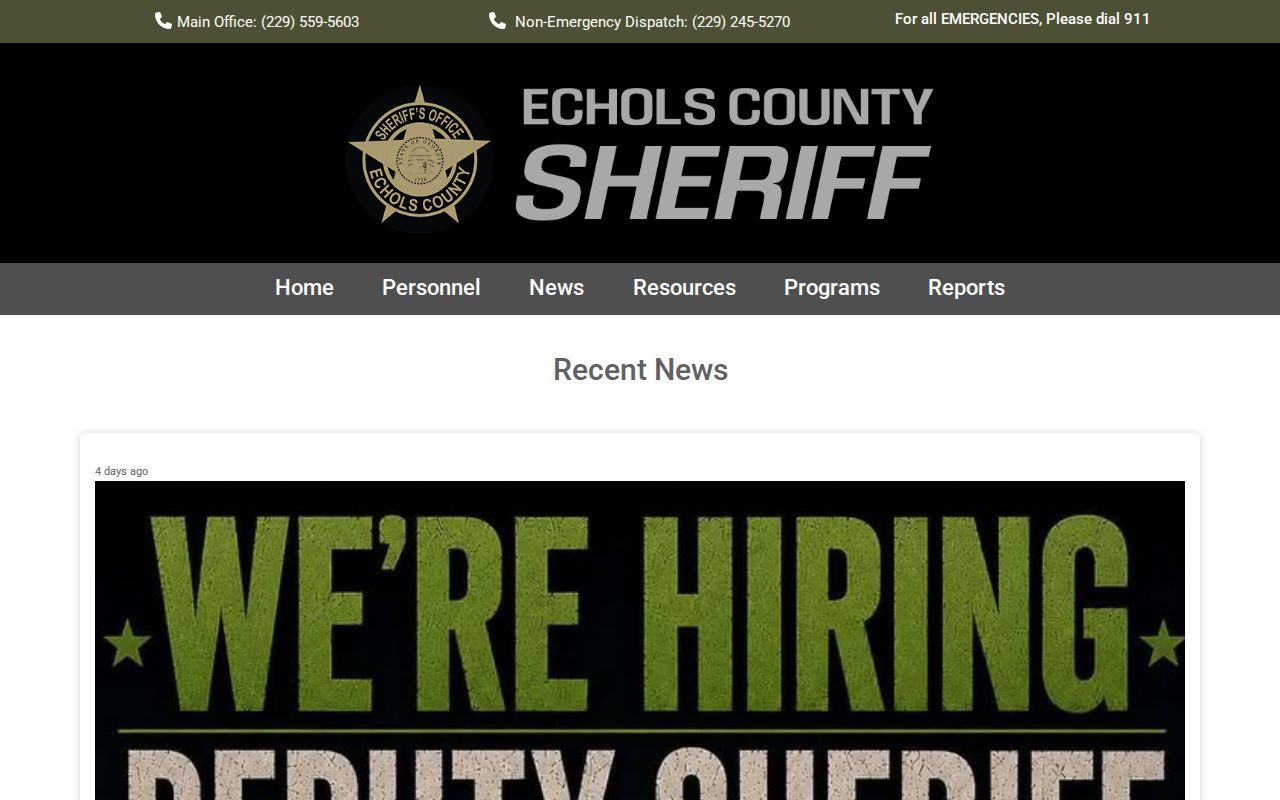
Local newsrooms borrow booking photos from agencies often. The right way to share one is a link, not a copied gallery. Keep phrases like "according to deputies" intact when you retell a story. Remember, a person can sit in the Echols County jail without ever earning a headline. So silence means little for the arrest record. A quick skim of any week proves the point. The WALB county news page reflects that spotty, story-driven pattern.
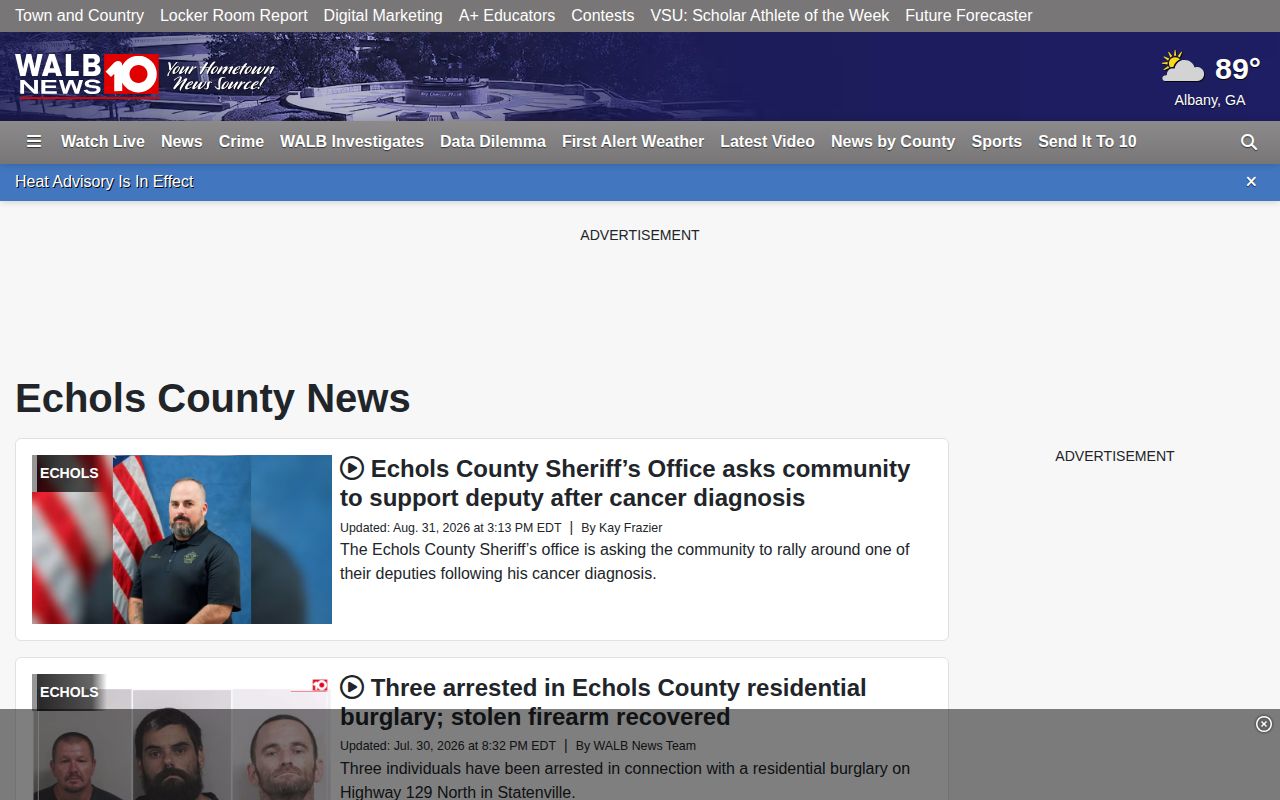
WALB is independent reporting, not an ECSO roster or a full count of Echols County arrests.
Archives, Retention, and Court Outcomes
Georgia keeps jail booking records for ten years after a person's release. Registers last ten years past the final entry. Those clocks cover the official file, not the web. A PDF can vanish sooner. The custodian may still hold the record long after the county site pulls it. The local retention schedule is the authoritative starting point. The Virtual Vault holds history, not a live Echols County arrest search.
For older bookings, give Lowndes the approximate release date, because retention runs from release. An old ECSO report needs an exact month. Case outcomes live elsewhere: use PeachCourt or the Echols Superior Court clerk. A filing may record a plea, a dismissal, or a judgment, so never infer an outcome from a charge line in a PDF.
| Research need | Correct source |
|---|---|
| Selected ECSO period | Sheriff’s Reports archive |
| Missing arrest or incident file | ECSO open-records request |
| Booking, bond, or release | Lowndes portal or records request |
| Final case result | Echols court record |
| State-prison history | GDC and state archives |
Third-party sites are no archive authority. Stale booking photos, wrong county labels, and incomplete charges show up on them, so confirm every material point with ECSO, Lowndes, the court, or a state agency.
Comparing Report and News Dates
Dates trip people up here. A report date may be the arrest date printed beside an entry, the month in a file title, or a later upload stamp. News runs on its own clock. A story published today can describe an arrest from months back. Keep all three labels straight. That discipline keeps you from placing a person in custody merely because a later article or PDF mentions the Echols County arrest.
When a report and a story clash, preserve each source's wording and attribution. Ask the custodian for the underlying arrest report rather than picking whichever public summary looks fuller. The court record settles what happened later.
Search Public Records
Sponsored Results